
UNet网络及其家族
UNet算法思想
UNet简介
- 论文来自:[1505.04597] U-Net: Convolutional Networks for Biomedical Image Segmentation
- 特点:
- 高效利用数据增强:使用弹性形变(elastic deformations)扩充数据集,少量数据图像便可训练
- 提供新型网络结构:使用收缩路径(contracting path)捕获信息和对称扩展路径(symmetric expanding path)精确定位,跳跃连接(Skip Connections)将两者结合的全卷积神经网络
- 提供新型训练策略:使用重叠瓦片策略(Overlap-tile strategy),使用加权损失函数,分隔触碰细胞的背景标签在损失函数中获取较大的权重
- 适用范围:生物医学图像处理,属于分类任务,但是特征与标签之间是1:n的关系,在图像的不同区域,标签不同
- 创新点(对比滑动窗口):
- 滑动窗口要对图像进行分割成不同的补丁(patch)图像,每个补丁对应一个标签,滑动窗口的补丁图像的数量大于原始图像的数量,且要对每个补丁图像进行训练,效率低下
- 如果补丁图像较大,定位精度不够,且需要更多的池化层,如果补丁图像太小,补丁图像与周围图像关系不太明显
UNet网络结构
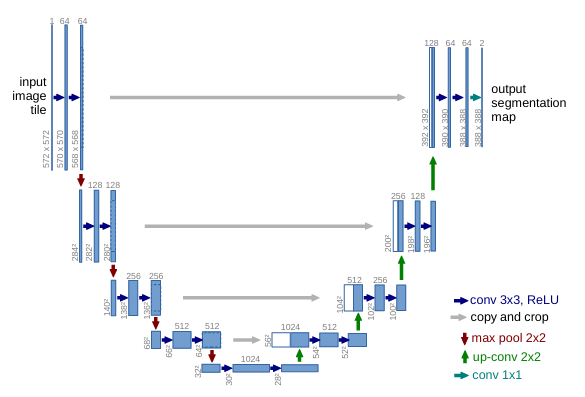
- 特点:
- 网络只使用卷积层,在U型结构的一侧使用池化层,对应的另一侧使用上采样层
- 剪切收缩路径的高分辨率特征并与扩展路径特征合并,如图上蓝白方框
- 使用收缩路径和扩展路径,收缩路径在左侧,扩展路径在右侧,形成“U”型结构
- 代码实现:
1
2
3
4
5
6
7
8
9
10
11
12
13
14
15
16
17
18
19
20
21
22
23
24
25
26
27
28
29
30
31
32
33
34
35
36
37
38
39
40
41
42
43
44
45
46
47
48
49
50
51
52
53
54
55
56
57
58
59
60
61
62
63
64
65
66
67
68
69
70
71
72
73
74
75
76
77
78
79
80
81
82
83
84
85
86
87
88
89
class UNet(nn.Module):
def __init__(self):
super(UNet, self).__init__()
# 卷积计算公式: output = (input - kernel_size + 2*padding) / stride + 1
# input (1, 572, 572)
self.layer1 = nn.Sequential(
nn.Conv2d(1, 64, 3, 1, 0), # output (64, 570, 570)
nn.ReLU(),
nn.Conv2d(64, 64, 3, 1, 0), # output (64, 568, 568)
nn.ReLU()
)
self.layer2 = nn.Sequential(
nn.MaxPool2d(2), # output (64, 284, 284)
nn.Conv2d(64, 128, 3, 1, 0), # output (128, 282, 282)
nn.ReLU(),
nn.Conv2d(128, 128, 3, 1, 0), # output (128, 280, 280)
nn.ReLU()
)
self.layer3 = nn.Sequential(
nn.MaxPool2d(2), # output (128, 140, 140)
nn.Conv2d(128, 256, 3, 1, 0), # output (128, 138, 138)
nn.ReLU(),
nn.Conv2d(256, 256, 3, 1, 0), # output (256, 136, 136)
nn.ReLU()
)
self.layer4 = nn.Sequential(
nn.MaxPool2d(2), # output (256, 68, 68)
nn.Conv2d(256, 512, 3, 1, 0), # output (512, 66, 66)
nn.ReLU(),
nn.Conv2d(512, 512, 3, 1, 0), # output (512, 64, 64)
nn.ReLU()
)
self.layer5 = nn.Sequential(
nn.MaxPool2d(2), # output (512, 32, 32)
nn.Conv2d(512, 1024, 3, 1, 0), # output (1024, 30, 30)
nn.ReLU(),
nn.Conv2d(1024, 1024, 3, 1, 0), # output (1024, 28, 28)
nn.ReLU(),
nn.ConvTranspose2d(1024, 512, 2, 2, 0) # output (512, 56, 56)
)
# 上采样计算公式:output = stride * (input - 1) + kernel_size - 2*padding + (input + 2 padding - kernel) mod stride
# input (1024, 56, 56)
self.layer6 = nn.Sequential(
nn.Conv2d(1024, 512, 3, 1, 0),
nn.ReLU(),
nn.Conv2d(512, 512, 3, 1, 0),
nn.ReLU(),
nn.ConvTranspose2d(512, 256, 2, 2, 0) # output (512, 104, 104)
)
self.layer7 = nn.Sequential(
nn.Conv2d(512, 256, 3, 1, 0), # output (256, 102, 102)
nn.ReLU(),
nn.Conv2d(256, 256, 3, 1, 0), # output (256, 100, 100)
nn.ReLU(),
nn.ConvTranspose2d(256, 128, 2, 2, 0) # output (256, 200, 200)
)
self.layer8 = nn.Sequential(
nn.Conv2d(256, 128, 3, 1, 0), # output (128, 198, 198)
nn.ReLU(),
nn.Conv2d(128, 128, 3, 1, 0), # output (128, 196, 196)
nn.ReLU(),
nn.ConvTranspose2d(128, 64, 2, 2, 0) # output (128, 392, 392)
)
self.layer9 = nn.Sequential(
nn.Conv2d(128, 64, 3, 1, 0), # output (64, 390, 390)
nn.ReLU(),
nn.Conv2d(64, 64, 3, 1, 0), # output (64, 388, 388)
nn.ReLU(),
nn.Conv2d(64, 2, 1, 1, 0)
)
# 前行传播
def forward(self, x):
skip1 = self.layer1(x)
skip2 = self.layer2(skip1)
skip3 = self.layer3(skip2)
skip4 = self.layer4(skip3)
output = self.layer5(skip4)
# 剪切
skip1 = skip1[:, 87: 479, 87: 479]
skip2 = skip2[:, 39: 239, 39: 239]
skip3 = skip3[:, 15: 119, 15: 119]
skip4 = skip4[:, 3: 59, 3: 59]
# 合并
output = self.layer6(torch.cat((skip4, output)))
output = self.layer7(torch.cat((skip3, output)))
output = self.layer8(torch.cat((skip2, output)))
output = self.layer9(torch.cat((skip1, output)))
return output - 模型参数量:31030658(float64)
- 模型输入输出:输入为(1, 572, 572)的灰度图像特征,输出为(C, 388, 388),其中C为类别数目,本例为C=2
训练过程
- 优化器:随机梯度下降(stochastic gradient desecnt),采用大动量(momentum=0.99)之前训练的结构将大幅决定本轮优化方向
- batch_size:一个图像,输入大图像而不是大批量
- 损失函数:对逐个像素使用soft-max函数,对整体特征图像采用交叉熵损失函数
交叉熵损失函数
- 应用:本论文的损失函数为像素级的交叉熵损失(Pixel-wise Cross-Entropy Loss),引入了一个创新的加权损失机制,用于突出细胞边界的重要性
- 公式:$$L = -\sum_{x \in \Omega}\sum_{c=1}^Cy_c(x)log(p_c(x))$$其中$\Omega$为像素全集,c为类别数量
soft-max函数
- 应用:对每个像素点应用
- 公式:$$p_k(x) = exp(a_k(x))/(\sum_{k=1}^K exp(a_k(x)))$$其中k表示的是分类,$p_k(x)$是最大近似函数,$a_k(x)$是在像素位置x的特征通道k的激活函数
加权交叉熵损失函数
- 特点:加权损失函数,为边界像素分配更高的权重
- 公式:$$w(x) = w_c(x) + w_0*exp(-\frac{(d_1(x) + d_2(x))^2}{2})$$其中$w_c$是权重地图平衡类别频率,$d_1$是到最近的细胞边界的距离,$d_2$是到第二近的细胞的距离,实验得$w_0 = 10 \quad \sigma = 5$
数据增广
几何变换
- 类型:
**平移(Translation)**:随机移动图像,模拟细胞在图像中的不同位置
**旋转(Rotation)**:随机旋转图像,增加对角度变化的鲁棒性
**缩放(Scaling)**:轻微缩放图像,模拟显微镜成像的不同放大倍率 - 原理:平移和旋转不变性(shift and rotation invariance)
- 注意:掩码与原图像要做相同的图像变换
弹性形变
- 定义:模拟生物组织的非刚性形变(如细胞的拉伸、扭曲),在生物医学图像中尤为重要,因为细胞形状和排列高度可变
- 步骤:
- 在图像上定义一个粗糙网格(论文提到 3x3 网格,覆盖整个图像)
- 为每个网格点生成随机位移向量(Random Displacement Vectors),基于高斯分布(“displacement vectors sampled from a Gaussian distribution”)
- 使用双线性插值将位移场平滑应用到整个图像,生成变形后的图像。
- 对分割掩码应用相同的位移场,确保一致性。
实例代码
1 | # 导入库函数 |
相关项目
UNet++算法思想
UNet++简介
- 论文来自:[1807.10165] UNet++: A Nested U-Net Architecture for Medical Image Segmentation
- 特点:
- 新型网络结构:深度监督编码解码网络(deeply-surpervised encoder-decoder Network),其中编码器,解码器通过一系列嵌套的密集的跳跃步骤,重新设计跳跃路径,减少编码器和解码器子网络特征图之间的语义差距
- 适用范围:生物医学领域的标注数据非常少,分割需要像素级预测
- 创新点:
- 特征融合不足:跳跃连接直接拼接编码器和解码器的特征图,但缺乏中间层次的特征融合,可能导致语义差距(Semantic Gap)
- 单一路径限制:U-Net 的单一编码-解码路径可能无法充分捕获多尺度特征,尤其在复杂组织结构(如肿瘤)分割中
网络结构
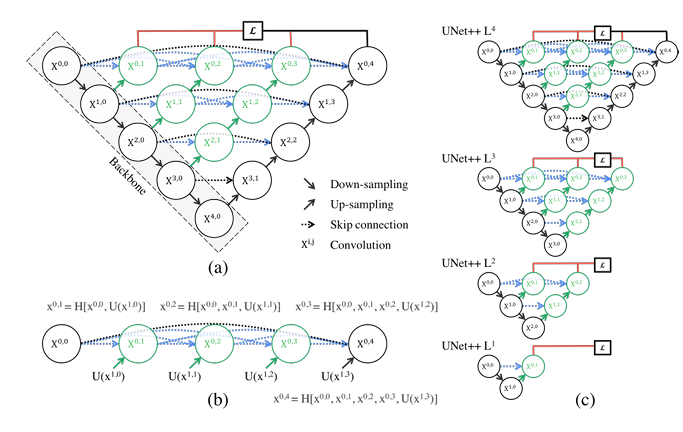
- 特点:
- 新型网络结构:引入密集跳跃连接(Dense Skip Connections),形成嵌套的子网络,增强多尺度特征融合
- **深度监督(Deep Supervision)**:
- **剪枝优化(Pruning)**:
- 实例代码:
1
2
3
4
5
6
7
8
9
10
11
12
13
14
15
16
17
18
19
20
21
22
23
24
25
26
27
28
29
30
31
32
33
34
35
36
37
38
39
40
41
42
43
44
45
46
47
48
49
50
51
52
53
54
55
56
57
58
59
60
61
62
63
64
65
66
67
68
69
70
71
72
73
74
75
76
77
78
79
80
81
82
83
84
85
86
87
88
89
90
91
92
93
94
95
96
97
98
99
100
101
102
103
104
105
106
107
# 双卷积块(Double Convolution)
class DoubleConv(nn.Module):
def __init__(self, in_channels, out_channels):
super(DoubleConv, self).__init__()
self.double_conv = nn.Sequential(
nn.Conv2d(in_channels, out_channels, kernel_size=3, padding=1, bias=False),
nn.BatchNorm2d(out_channels), # 论文未明确使用 BN,现代实现常添加
nn.ReLU(inplace=True),
nn.Conv2d(out_channels, out_channels, kernel_size=3, padding=1, bias=False),
nn.BatchNorm2d(out_channels),
nn.ReLU(inplace=True)
)
def forward(self, x):
return self.double_conv(x)
# 下采样模块(Downsampling)
class Down(nn.Module):
def __init__(self, in_channels, out_channels):
super(Down, self).__init__()
self.maxpool_conv = nn.Sequential(
nn.MaxPool2d(kernel_size=2, stride=2),
DoubleConv(in_channels, out_channels)
)
def forward(self, x):
return self.maxpool_conv(x)
# 上采样模块(Upsampling)
class Up(nn.Module):
def __init__(self, in_channels, out_channels):
super(Up, self).__init__()
self.up = nn.ConvTranspose2d(in_channels, in_channels // 2, kernel_size=2, stride=2)
self.conv = DoubleConv(in_channels, out_channels) # 输入通道数为拼接后的通道数
def forward(self, x1, skip_connections):
x1 = self.up(x1)
# 调整尺寸以匹配 skip_connections
diffY = skip_connections[0].size()[2] - x1.size()[2]
diffX = skip_connections[0].size()[3] - x1.size()[3]
x1 = F.pad(x1, (diffX // 2, diffX - diffX // 2, diffY // 2, diffY - diffY // 2))
# 拼接所有 skip_connections
x = torch.cat([x1] + skip_connections, dim=1)
return self.conv(x)
# UNet++ 模型
class UNetPlusPlus(nn.Module):
def __init__(self, n_channels, n_classes, deep_supervision=True, level=4):
super(UNetPlusPlus, self).__init__()
self.deep_supervision = deep_supervision
self.level = level
# 编码器
self.inc = DoubleConv(n_channels, 64)
self.down1 = Down(64, 128)
self.down2 = Down(128, 256)
self.down3 = Down(256, 512)
self.down4 = Down(512, 1024)
# 解码器节点(X^{i,j})
self.up1 = {} # 存储上采样节点
self.outc = {} # 存储输出卷积
# 初始化解码器节点
for i in range(4): # 对应 4 个下采样级别
for j in range(1, self.level + 1 - i): # 嵌套路径数随级别减少
if i == 0: # 顶层输出节点
self.up1[f'x{i}_{j}'] = Up(2 ** (6 - i) * 2 ** j, 2 ** (6 - i))
self.outc[f'x{i}_{j}'] = nn.Conv2d(2 ** (6 - i), n_classes, kernel_size=1)
else:
self.up1[f'x{i}_{j}'] = Up(2 ** (7 - i) * 2 ** (j - 1), 2 ** (6 - i))
# 将字典转换为 nn.ModuleDict
self.up1 = nn.ModuleDict(self.up1)
self.outc = nn.ModuleDict(self.outc)
def forward(self, x):
# 编码器路径
x0_0 = self.inc(x) # 64, H, W
x1_0 = self.down1(x0_0) # 128, H/2, W/2
x2_0 = self.down2(x1_0) # 256, H/4, W/4
x3_0 = self.down3(x2_0) # 512, H/8, W/8
x4_0 = self.down4(x3_0) # 1024, H/16, W/16
# 解码器路径与嵌套连接
outputs = []
nodes = {(0, 0): x0_0, (1, 0): x1_0, (2, 0): x2_0, (3, 0): x3_0, (4, 0): x4_0}
for i in range(4, -1, -1): # 从深到浅
for j in range(1, self.level + 1 - i):
# 收集 skip connections
skip_connections = [nodes[(i, k)] for k in range(j)]
# 上采样输入
x_upper = nodes[(i + 1, j - 1)] if (i + 1, j - 1) in nodes else None
if x_upper is None:
continue
# 计算当前节点
nodes[(i, j)] = self.up1[f'x{i}_{j}'](x_upper, skip_connections)
# 顶层节点输出分割图
if i == 0 and self.deep_supervision:
outputs.append(self.outc[f'x{i}_{j}'](nodes[(i, j)]))
# 如果禁用深度监督,仅返回 x0_1
if not self.deep_supervision:
outputs = [self.outc['x0_1'](nodes[(0, 1)])]
return outputs
本博客所有文章除特别声明外,均采用 CC BY-NC-SA 4.0 许可协议。转载请注明来源 LinHao's Pages!